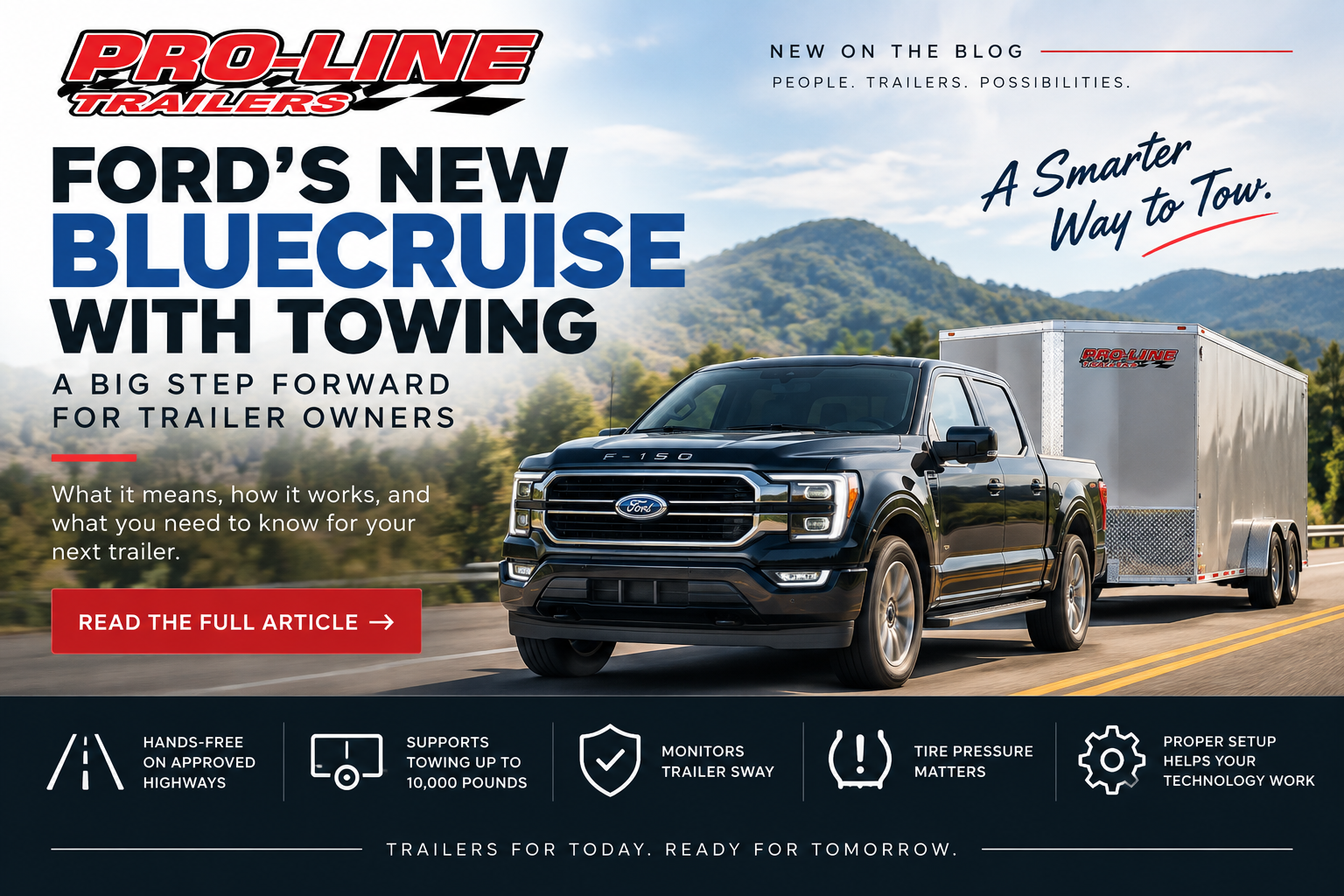
Ford has announced something trailer owners have been waiting for: BlueCruise with Towing is coming to the 2027 Ford F-150.
For the first time, properly equipped F-150 owners will be able to use Ford’s hands-free, eyes-on BlueCruise system while towing a trailer on approved divided highways. Ford says the system will support towing up to 10,000 pounds when properly configured. (Ford From the Road)
For trailer buyers, this is more than another truck technology announcement. It is a sign of where towing is headed: the truck and trailer are becoming a more connected system.
What Is BlueCruise With Towing?
BlueCruise is Ford’s advanced driver-assistance system designed to handle steering, acceleration, and braking on designated sections of divided highway while the driver remains attentive to the road.
With the 2027 F-150, Ford is extending that capability to towing.
Ford says more than 75% of F-150 customers use their trucks to tow, which made towing support an obvious next step for the technology. (Ford From the Road)
There are important limitations. This is driver assistance, not autonomous driving. The driver must remain alert and ready to take control at all times.
Your Trailer Setup Will Matter More Than Ever
One of the most important details in Ford’s announcement is the requirement for a unique trailer profile.
Before BlueCruise with Towing can operate, the driver must enter accurate information about the trailer being pulled. Ford specifically says trailer dimensions, type, size, weight, loading, and configuration matter to system operation. (Ford From the Road)
That makes proper trailer selection and setup increasingly important.
A modern towing system is no longer concerned only with whether the truck has enough advertised towing capacity. The entire combination matters:
- Trailer GVWR and actual loaded weight
- Payload
- Truck configuration
- Hitch setup
- Weight distribution
- Trailer brakes
- Tire pressure
- Load placement
- Trailer dimensions
- Electrical connections
Those have always mattered for safe towing. Technology like BlueCruise makes accurate setup even more important because the truck’s software is now using some of that information to determine how it should behave.
Ford Will Monitor Trailer Sway
Ford says BlueCruise with Towing will actively monitor trailer sway.
If persistent sway is detected, the system can slow the vehicle, limit speed, or require the driver to resume hands-on control. (Ford From the Road)
Ford says engineers tested dozens of truck-and-trailer combinations across high elevations, curves, high winds, and different load distributions while developing the system. (Ford From the Road)
That is important because anyone who regularly tows knows that two trailers weighing the same amount do not necessarily behave the same way.
Trailer length, height, axle placement, tongue weight, wind resistance, load placement, and suspension can all change towing dynamics.
Tire Pressure Can Disable the System
Another important detail for trailer owners: Ford says BlueCruise with Towing will not operate if the vehicle detects certain weight limits have been exceeded or if a tire-pressure-monitoring warning is active. (Ford From the Road)
That reinforces something experienced trailer owners already know:
Maintenance affects more than reliability. Increasingly, it affects whether your truck’s technology will work at all.
Tires, brakes, bearings, wiring, breakaway systems, and proper loading should be treated as part of the towing system rather than separate maintenance items.
There Are Still Limits
BlueCruise with Towing will initially be available on the 2027 Ford F-150 and requires a BlueCruise-equipped truck with an active BlueCruise plan or trial. (Ford From the Road)
Ford also says:
- BlueCruise with Towing will only operate on approved Blue Zone highways.
- Maximum BlueCruise towing speed is 75 mph.
- Hands-free lane changes will not be available while towing.
- In-Lane Repositioning will be disabled while towing.
- Construction zones may require the driver to put their hands back on the wheel.
- Trailer type, size, and weight restrictions apply. (Ford From the Road)
Ford currently lists more than 130,000 miles of eligible divided highways for BlueCruise operation. (Ford From the Road)
What This Means for Trailer Buyers
This announcement points toward a larger change in towing.
For decades, the relationship between truck and trailer was mostly mechanical and electrical.
Hitch it correctly. Connect the wiring. Set the brake controller. Check the load. Go.
That is changing.
Modern trucks increasingly understand what they are towing and can adjust braking, steering, cameras, stability controls, driver-assistance systems, and other features accordingly.
That means buying the right trailer increasingly includes understanding how that trailer works with the technology in your tow vehicle.
At Pro-Line Trailers, that is where knowledgeable trailer selection becomes particularly valuable.
The right conversation should include more than:
“How much trailer can my truck tow?”
It should also include:
What are you hauling?
How will you load it?
How often will you tow?
What truck are you using?
What towing technology does your truck have?
Those answers help determine the trailer configuration that actually fits the job.
Smart Trucks Still Need Smart Trailer Owners
Technology can make towing easier and more comfortable.
It cannot replace proper trailer selection, loading, maintenance, or driver judgment.
Ford itself makes that clear. BlueCruise remains a driver-assistance system, and drivers are responsible for proper trailer attachment, configuration, and loading. (Ford From the Road)
That is probably the most important takeaway from the announcement.
As tow vehicles become smarter, properly matching the truck, trailer, load, and technology becomes even more important.
If you’re considering a new trailer, bring us the truck you’re towing with and tell us what you’re trying to accomplish.
We’ll help you think through the entire setup, not just the trailer sitting on the lot.
Pro-Line Trailers
www.prolinetrailers.com
BlueCruise is a Ford driver-assistance feature and does not replace attentive driving. Availability, compatibility, towing limits, and operating requirements vary by vehicle and trailer configuration. Consult Ford’s current owner’s materials and towing guides for your specific vehicle.