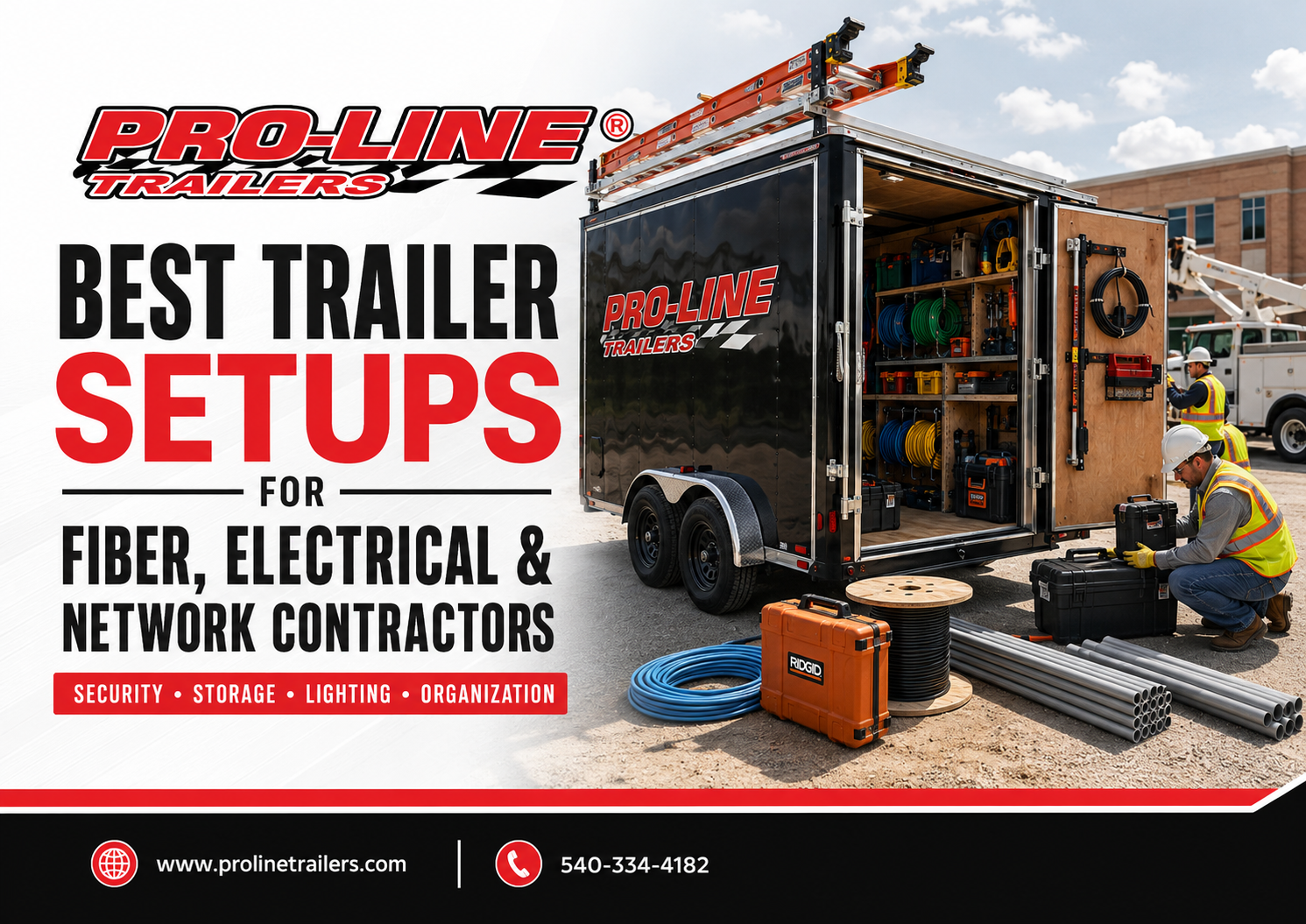
For fiber installers, electrical contractors, and network service crews, a trailer does much more than move equipment.
It protects expensive tools, organizes job-critical supplies, reduces wasted time, and gives the crew a reliable mobile base between jobsites.
The wrong trailer can create daily frustration. Tools disappear into piles, cable gets damaged, equipment gets exposed to weather, and crews waste time unloading gear just to reach one item.
The right trailer setup makes the work easier.
What is the best trailer for technology contractors?
For many fiber, electrical, and network contractors, an enclosed trailer provides the best combination of security, weather protection, organization, and upgrade potential.
However, the right choice depends on:
- What the crew carries
- How much the equipment weighs
- How often crews need access
- Whether tools must stay dry and secure
- How the trailer will be organized
- What the tow vehicle can safely handle
- Whether the business expects to add equipment later
Some crews may need a compact single-axle enclosed trailer. Others may need a larger tandem-axle trailer with shelving, ladder racks, lighting, work surfaces, and multiple access points.
Start with the work. Then choose the trailer.
Why enclosed trailers work well for contractor crews
Fiber, electrical, and network crews often carry high-value tools and sensitive equipment.
That may include:
- Cable reels
- Fiber-splicing equipment
- Electrical meters
- Testing equipment
- Power tools
- Ladders
- Conduit tools
- Connectors
- Safety equipment
- Replacement components
- Jobsite lighting
- Extension cords
- Small generators
- Personal protective equipment
An enclosed trailer helps protect these items from rain, road debris, and unnecessary exposure.
It also gives the business walls, floors, doors, and ceiling space that can support a more organized layout.
Best trailer setup for fiber installation crews
Fiber crews need to protect cable, connectors, splicing tools, test equipment, and smaller components.
Their trailer should support organization and fast access.
Useful features for fiber crews
- Shelving for bins and small parts
- Dedicated cable and reel storage
- Protected space for testing equipment
- Interior LED lighting
- Side-door access
- Workbench or prep surface
- Tie-down points
- Exterior ladder rack
- Ventilation
- Lockable cabinets
- Clearly labeled storage zones
Cable should not roll loose across the floor or block access to other equipment.
A strong layout separates cable storage, tools, testing equipment, and frequently used supplies.
Door configuration matters
Fiber crews should consider how they enter and load the trailer.
A side door gives technicians quick access to everyday tools without opening the rear.
Barn doors may work well for straightforward cargo access.
A ramp door can help when crews move wheeled equipment, carts, or heavier cases.
The best door setup depends on the workflow, not appearance.
Best trailer setup for electrical contractors
Electrical contractors carry a wide mix of long materials, heavy tools, small parts, and testing equipment.
A trailer setup should help crews manage all four.
Useful features for electrical crews
- Shelving and parts bins
- Conduit and pipe storage
- Ladder racks
- Cord and hose hangers
- Lockable tool storage
- Interior lighting
- Workbench space
- Side access
- Floor tie-downs
- Battery charging area
- Ventilation
- Spare-part inventory zones
The trailer should make frequently used items easy to reach.
Small parts should have labeled locations. Long materials should stay secured. Heavy tools should sit low and close to the axle area when practical.
Poor weight placement can affect towing stability even when the trailer remains under its maximum weight rating.
Best trailer setup for network and technology service teams
Network service crews may carry routers, switches, test equipment, cable, tools, replacement parts, cases, and temporary connectivity equipment.
Some of this gear needs more protection than ordinary construction supplies.
Useful features for network crews
- Lockable equipment cabinets
- Padded or secured storage areas
- Climate-control planning
- Power access
- Interior lighting
- Work surfaces
- Cable-routing space
- Organized replacement-part storage
- Side-door access
- Security upgrades
- Ventilation
- Floor and wall tie-down systems
Businesses should avoid treating electronic equipment like general cargo.
Sensitive gear needs protection from impact, moisture, excessive heat, and uncontrolled movement.
Any trailer intended to support electronics, batteries, power systems, or climate-sensitive equipment requires careful planning and qualified installation.
Single axle or tandem axle?
This decision depends on total loaded weight, trailer size, towing needs, and future growth.
Single-axle trailers
A single-axle enclosed trailer may fit smaller crews that carry lighter equipment and need a compact, easy-to-maneuver setup.
Potential advantages include:
- Lower purchase price
- Smaller towing footprint
- Easier maneuverability
- Good fit for lighter daily use
The limitation comes from capacity.
Shelving, tools, cable, ladders, batteries, and equipment add weight quickly.
Tandem-axle trailers
A tandem-axle enclosed trailer may work better for growing crews, heavier loads, longer distances, or more elaborate interior builds.
Potential advantages include:
- Greater payload potential
- More stable towing
- Better fit for larger layouts
- More room for growth
- Better support for heavier equipment
A tandem axle does not remove the need for proper loading.
The tow vehicle, hitch, brake controller, tires, axle ratings, and loaded trailer weight all still matter.
How much trailer space does a contractor need?
Buyers often focus on floor length and overlook workflow.
A trailer can technically hold the equipment while still being difficult to use.
Contractors should consider:
- How much aisle space the crew needs
- Whether doors can open with equipment loaded
- Whether technicians can reach shelves safely
- Whether ladders or conduit block access
- Whether the trailer needs room for a workbench
- Whether future equipment will fit
- Whether the crew needs to work inside the trailer
- Whether equipment can be loaded without unloading something else
The goal is not to fill every inch.
The goal is to make the trailer work efficiently.
Contractor trailer feature checklist
| Feature | Why It Matters |
|---|---|
| Interior shelving | Keeps tools and supplies visible and organized |
| Parts bins | Prevents small components from disappearing |
| LED lighting | Improves visibility and safety |
| Side door | Provides quick access to daily-use equipment |
| Ramp or barn doors | Supports different loading needs |
| Ladder racks | Keeps long equipment out of the interior |
| Tie-down points | Secures tools, carts, and equipment |
| Lock upgrades | Adds protection for high-value tools |
| Workbench | Supports prep, repair, and organization |
| Ventilation | Helps manage heat and enclosed workspace conditions |
| Tandem axles | May provide greater capacity and stability |
| Spare tire | Helps reduce downtime after a tire issue |
Do not forget payload
One of the biggest contractor mistakes is buying based on available space instead of available payload.
Everything counts toward trailer weight:
- Shelving
- Cabinets
- Workbenches
- Tools
- Cable
- Ladders
- Batteries
- Generators
- Spare parts
- Mounted accessories
- Climate-control equipment
- The spare tire
A trailer can look half empty and still carry too much weight.
Contractors should estimate the fully loaded weight before purchasing and leave room for future additions.
Security should be part of the setup
Contractor tools attract theft.
An enclosed trailer provides more protection than an open trailer, but the trailer still needs a security plan.
Consider:
- Strong coupler locks
- Quality door locks
- Reinforced access points
- Lockable cabinets
- Lighting around overnight parking
- Inventory tracking
- GPS or location tracking
- Parking position
- Removing high-value portable equipment when practical
No lock makes a trailer theft-proof.
The goal is to make theft harder, protect the most valuable equipment, and reduce unnecessary exposure.
Trailer organization saves labor
A disorganized trailer costs more than frustration.
It costs time.
When a technician spends 15 minutes looking for a fitting, meter, connector, or tool, the business pays for that delay.
Multiply it across several employees and several jobs each week, and trailer organization becomes an operating issue.
A better setup should help crews:
- Find equipment quickly
- Identify missing items
- Restock efficiently
- Load consistently
- Reduce damaged tools
- Keep walkways clear
- Avoid repeated unloading
- Prepare faster for the next job
The trailer should support the crew’s workflow every day.
Common contractor trailer mistakes
Buying too small
A trailer that barely fits current equipment leaves no room for growth or better organization.
Ignoring loaded weight
Empty trailer weight does not reflect daily operating weight.
Installing shelves without a load plan
Shelving changes weight distribution and reduces payload.
Blocking door access
Poorly placed storage can make side and rear doors harder to use.
Carrying loose cable and tools
Unsecured equipment can shift, become damaged, or create a safety hazard.
Skipping lighting
A dark trailer slows crews down and increases the chance of trips, cuts, and missed equipment.
Forgetting service needs
Trailer brakes, axles, tires, bearings, wiring, roofs, doors, panels, and safety chains need inspection and maintenance.
Keep the trailer road-ready
A contractor trailer works hard.
Daily miles, jobsite conditions, heavy loads, weather exposure, and repeated loading all create wear.
Pro-Line Trailers can help with enclosed trailer service, including:
- Double-door replacement
- Roof replacement
- Exterior panel replacement
- Safety-chain upgrades
- Axle service
- Tire upgrades
- Wiring and lighting repair
- Parts installation
- General trailer inspection and maintenance
Addressing damage early can help prevent larger problems and reduce downtime.
The Pro-Line Trailers advantage
Pro-Line Trailers helps contractors compare enclosed, utility, equipment, and custom-friendly trailer options based on real work requirements.
The team can help buyers think through:
- Trailer size
- Axle configuration
- Payload
- Door placement
- Towing needs
- Interior organization
- Accessory options
- Financing
- Parts
- Service
- Long-term use
For contractors, the trailer should not simply carry equipment.
It should help the business operate better.
Frequently asked questions
What size enclosed trailer works best for an electrical contractor?
The right size depends on the tools, ladders, wire, conduit, parts, and equipment the crew carries. Smaller crews may use compact enclosed trailers, while larger teams often need tandem-axle models with more storage and aisle space.
Are tandem-axle trailers better for fiber crews?
Tandem axles may offer more payload capacity and towing stability, especially when the trailer carries shelving, cable reels, tools, workbenches, and equipment. The final choice should match the loaded weight and tow vehicle.
Can a contractor add shelving after buying a trailer?
Yes, but shelving adds weight and affects layout. Plan shelf placement, payload, fasteners, access, and weight distribution before installation.
Should a contractor choose a ramp door or barn doors?
Choose based on what the crew loads. Ramp doors work well for carts and wheeled equipment. Barn doors may provide simpler cargo access and require less loading space behind the trailer.
How can contractors protect tools inside a trailer?
Use enclosed storage, quality locks, lockable cabinets, organized tie-downs, secure parking, inventory controls, and tracking systems where appropriate.
Does Pro-Line service enclosed contractor trailers?
Yes. Pro-Line provides enclosed trailer repairs and upgrades, including door, roof, panel, safety-chain, axle, tire, wiring, and parts-related service. Call to discuss the trailer’s condition.
Build the trailer around the work
Fiber, electrical, and network contractors do not need a trailer that simply looks impressive.
They need a trailer that protects equipment, saves time, handles the load, and supports the crew’s daily workflow.
Start with what the crew carries.
Plan for access, security, payload, organization, towing, service, and future growth.
Then choose a trailer built around the job.
Find the right contractor trailer
Browse enclosed and contractor-friendly trailers online or call Pro-Line Trailers.
For trailer lighting, locks, tie-downs, replacement parts, and accessories.
Ask about current enclosed trailer inventory, financing options, service, and available upgrades.
Pro-Line Trailers: For Work and Play.