Summer puts trailers to work.
Contractors haul equipment in the heat. Landscapers run from job to job. Families load up for weekends. Race teams head to the track. Homeowners move mulch, furniture, ATVs, motorcycles, tools, and project supplies.
More miles means more wear.
That is why a trailer that seemed fine in the driveway can become a problem fast once heat, weight, speed, hills, and long road time enter the picture.
Before your trailer hits the road this summer, take time to check the basics. A few minutes now can save you from a breakdown, a safety issue, a damaged load, or a ruined trip.
The Direct Answer: What Should You Check Before Summer Hauling?
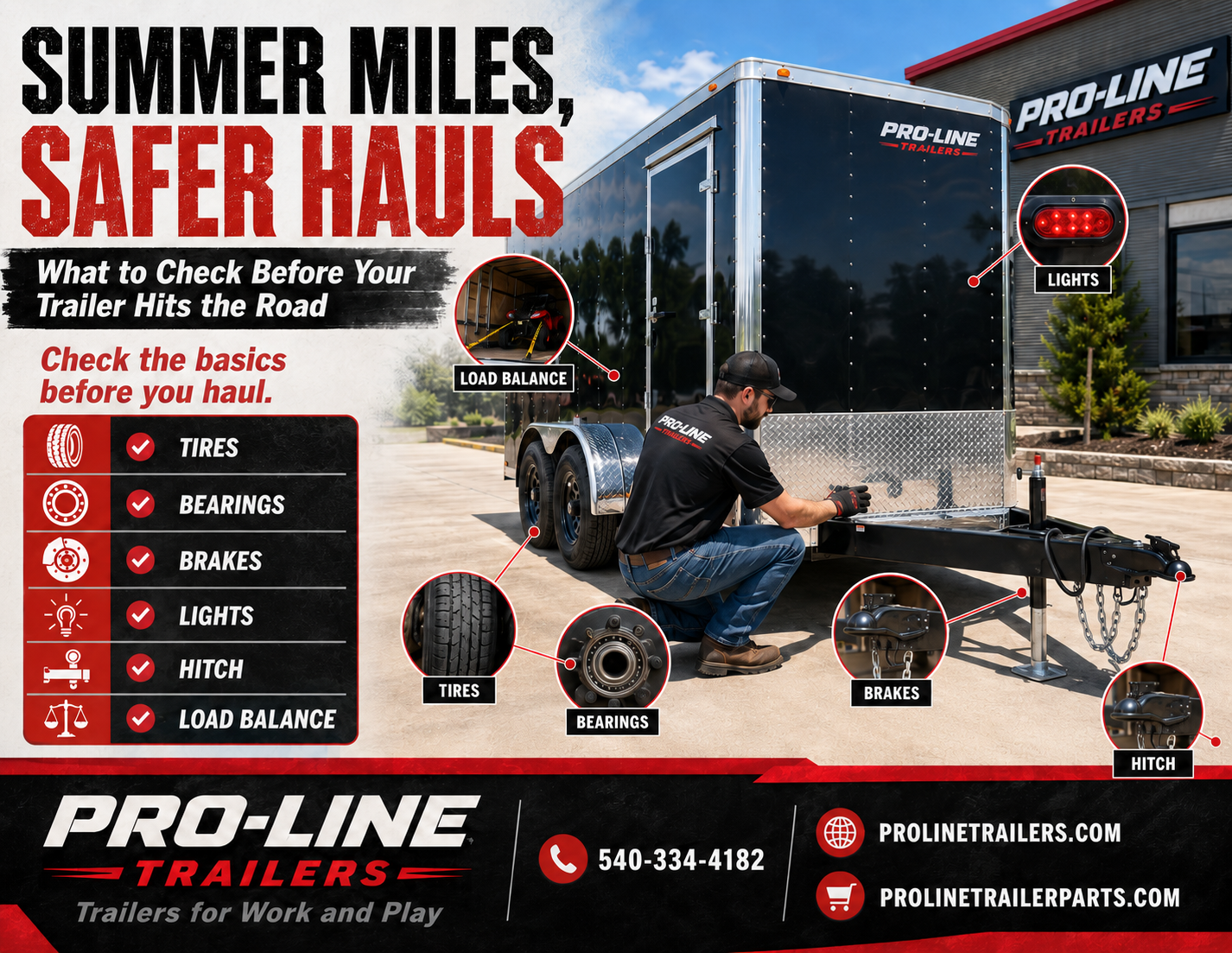
Before summer hauling, check your trailer’s tires, wheel bearings, brakes, lights, wiring, coupler, safety chains, breakaway system, ramps, doors, flooring, tie-downs, load balance, and hitch setup.
You should also confirm that your tow vehicle can safely handle the loaded trailer, not just the empty trailer.
Here is the short version:
- Check tire pressure and tread
- Inspect wheel bearings
- Test brakes
- Test all lights
- Inspect wiring
- Check coupler and hitch connection
- Inspect safety chains
- Test the breakaway battery
- Look over ramps and doors
- Check flooring and frame condition
- Confirm tie-down points
- Balance the load correctly
- Carry a spare tire and basic tools
- Schedule service before problems show up on the road
Summer trailer safety is not complicated, but it does require attention.
Why Summer Hauling Can Be Hard on Trailers
Heat exposes weak spots.
A trailer may sit for weeks or months, then suddenly haul a heavy load on hot pavement at highway speeds. That can stress tires, bearings, brakes, wiring, suspension, and moving parts.
Summer also brings longer trips, heavier weekend use, more construction work, more landscaping loads, and more recreational hauling.
That means your trailer may face:
- Hot pavement
- Higher tire temperatures
- Longer towing distances
- Heavier loads
- Stop-and-go traffic
- Mountain roads
- Dust, gravel, and jobsite conditions
- Rainstorms and humidity
- More frequent loading and unloading
If something already needs attention, summer will usually find it.
Start With the Tires
Trailer tires matter more than many owners realize.
A tire failure can damage the trailer, damage the load, slow down the job, and create a serious road hazard.
What to check:
- Tire pressure
- Tread depth
- Cracks in the sidewall
- Bulges
- Uneven wear
- Nails, screws, or damage
- Valve stems
- Tire age
- Spare tire condition
Do not check pressure after a long drive and assume that number tells the full story. Tires heat up as you tow. Check pressure when the tires are cold and follow the proper rating for your trailer tires.
Common tire mistake:
Running trailer tires underinflated.
Underinflated tires can build heat faster, wear unevenly, and fail under load. That risk increases in summer.
Check the Wheel Bearings
Wheel bearings help your trailer wheels roll smoothly.
When bearings run dry, get contaminated, or wear out, they can create heat, noise, wheel problems, and serious breakdowns.
Warning signs to watch for:
- Grinding noise
- Heat near the hub
- Grease leaking around the hub
- Wheel wobble
- Rough rotation
- Vibration
- Trailer pulling oddly
If you haul often, schedule bearing service before heavy summer use. This matters even more for work trailers, boat trailers, equipment trailers, and any trailer that sits for long stretches before a big trip.
Common bearing mistake:
Ignoring bearings until they fail.
By the time a bearing makes obvious noise or heat, you may already have a bigger problem.
Test the Brakes Before You Need Them
Trailer brakes help control the load.
If your trailer has brakes, do not assume they work just because the trailer moves fine. Test them before hauling.
What to check:
- Brake controller function
- Brake response
- Wiring connection
- Breakaway system
- Brake wear
- Unusual noises
- Pulling or grabbing
- Weak braking
A loaded trailer changes stopping distance. That matters in traffic, on hills, in rain, and during emergency stops.
Common brake mistake:
Testing brakes only after loading heavy.
Check before the trailer carries the load. That gives you time to fix problems.
Test Every Light
Trailer lights help other drivers understand what you plan to do.
Bad lights create a safety risk, especially at night, in rain, in traffic, or on rural roads.
Check:
- Brake lights
- Turn signals
- Running lights
- Marker lights
- Reverse lights if equipped
- License plate light
- Plug connection
- Ground wire
- Corrosion
- Loose wiring
Have someone stand behind the trailer while you test lights, or use a reflective surface if you are working alone.
Common lighting mistake:
Assuming a quick plug-in means everything works.
A trailer can connect and still have a bad ground, broken wire, blown bulb, or damaged plug.
Inspect the Coupler, Hitch, and Safety Chains
Your trailer connection needs attention every time you tow.
A strong trailer means nothing if the connection point fails.
Check:
- Correct hitch ball size
- Coupler latch
- Locking pin
- Safety chains
- Chain crossing under the tongue
- Chain length
- Breakaway cable
- Jack position
- Tongue condition
- Hitch receiver
- Ball mount
- Trailer level
The trailer should ride level when loaded. Too much nose-up or nose-down angle can affect towing, braking, tire wear, and control.
Common hitch mistake:
Using the wrong ball size.
A coupler and hitch ball must match. Close enough does not count.
Do Not Skip the Breakaway System
If your trailer has electric brakes, the breakaway system matters.
It acts as a backup if the trailer separates from the tow vehicle. The system needs a charged battery and a working switch.
Check:
- Breakaway battery charge
- Cable condition
- Switch function
- Wiring
- Mounting location
Do not wrap the breakaway cable around the safety chains in a way that prevents it from doing its job.
Common breakaway mistake:
Letting the battery die.
A breakaway system without battery power cannot protect you the way it should.
Look Over Ramps, Doors, Gates, and Latches
Summer hauling often means repeated loading and unloading.
That puts ramps, doors, gates, springs, hinges, cables, and latches to work.
Check:
- Rear ramp door
- Ramp cables
- Hinges
- Spring assist
- Barn doors
- Side doors
- Door seals
- Door latches
- Gate pins
- Ramp gate mesh
- Slide-in ramps
- Dump gate hardware
A ramp problem can turn a simple load into a dangerous mess.
Common ramp mistake:
Loading heavy equipment on a ramp that has damage.
Inspect ramps before loading mowers, ATVs, motorcycles, machines, or heavy cargo.
Inspect the Floor and Frame
The floor carries the load.
The frame supports the trailer.
Both deserve a real look before heavy summer use.
Check the floor for:
- Soft spots
- Cracks
- Rot
- Loose boards
- Warping
- Oil damage
- Water damage
- Fastener issues
Check the frame for:
- Cracks
- Rust
- Bent areas
- Broken welds
- Loose hardware
- Suspension problems
- Axle concerns
A trailer can look fine from a distance and still have floor or frame issues that matter under load.
Common floor mistake:
Ignoring soft spots because the trailer still looks usable.
Soft flooring can get worse fast, especially when equipment rolls over the same area repeatedly.
Secure the Load the Right Way
A good trailer still needs a secure load.
Loose cargo can shift, fall, damage the trailer, damage the tow vehicle, or create road danger.
Check:
- Tie-down straps
- Chains
- Binders
- Anchor points
- Wheel chocks
- Load height
- Load balance
- Weight distribution
- Loose tools
- Fuel cans
- Ladders
- Yard equipment
- Doors and lids
As a general rule, heavier weight should sit low and balanced. Do not overload the rear of the trailer. Poor weight distribution can cause sway and control problems.
Common load mistake:
Trusting weight alone to hold cargo in place.
Weight can shift. Tie it down.
Match the Trailer to the Tow Vehicle
Your trailer and truck need to work as a team.
Do not only ask, “Can my truck pull it?”
Ask, “Can my truck safely control it, stop it, handle the tongue weight, and manage the load under real road conditions?”
Check:
- Tow rating
- Payload rating
- Tongue weight
- Hitch rating
- Brake controller
- Tire condition
- Mirrors
- Suspension
- Load weight
- Trailer brakes
A loaded trailer changes how the tow vehicle accelerates, turns, stops, and handles.
Common towing mistake:
Using empty trailer weight instead of loaded trailer weight.
The load matters.
Summer Trailer Safety Checklist
Use this before your next haul.
| Trailer Area | What to Check | Why It Matters |
|---|---|---|
| Tires | Pressure, tread, cracks, spare | Reduces blowout risk |
| Bearings | Heat, grease, noise, service history | Prevents hub and wheel problems |
| Brakes | Brake controller, response, wiring | Improves stopping control |
| Lights | Brake, turn, marker, running lights | Helps other drivers see you |
| Hitch | Ball size, coupler, pin, level | Keeps trailer connected properly |
| Chains | Crossed, correct length, secure | Adds backup connection |
| Breakaway | Battery, switch, cable | Supports emergency braking |
| Ramps | Hinges, cables, surface, latches | Makes loading safer |
| Doors | Latches, seals, hinges | Protects cargo and access |
| Floor | Soft spots, cracks, rot | Supports the load safely |
| Frame | Rust, cracks, welds, suspension | Protects trailer structure |
| Cargo | Tie-downs, balance, loose items | Prevents load movement |
What Trailer Owners Should Keep With Them
A basic trailer road kit can save time.
Consider carrying:
- Spare tire
- Lug wrench
- Jack rated for the trailer
- Tire pressure gauge
- Wheel chocks
- Extra straps
- Work gloves
- Flashlight
- Basic tool kit
- Electrical tape
- Spare fuses
- Grease if appropriate
- Reflective triangles
- Battery jump pack
- First aid kit
You do not need to carry a full repair shop, but a few basics can keep a small problem from ruining the day.
When Should You Schedule Trailer Service?
Schedule service before peak use, not after something breaks.
That matters if you use your trailer for:
- Daily business hauling
- Landscaping
- Construction
- Equipment transport
- Race weekends
- Long trips
- Heavy loads
- Out-of-state hauling
- Family travel
- Summer projects
If you cannot remember the last time you checked bearings, brakes, tires, or wiring, that is your sign.
Call Pro-Line Trailers to ask about service and repair support.
Parts That Often Need Attention
Trailer owners often need parts before or during busy hauling season.
Common needs include:
- Trailer tires
- Wheels
- Lights
- Wiring plugs
- Brake parts
- Bearings and hubs
- Jacks
- Couplers
- Safety chains
- Straps
- Tie-down hardware
- Door hardware
- Ramp hardware
- Fenders
- Hitch parts
Need trailer parts? Shop Online.
Buyer Mistakes to Avoid
Mistake 1: Waiting Until the Morning of the Trip
Do not inspect your trailer 20 minutes before you need to leave.
Give yourself time to fix what you find.
Mistake 2: Checking the Truck but Not the Trailer
Many owners keep the tow vehicle maintained but ignore the trailer. The trailer carries the load. It deserves attention too.
Mistake 3: Assuming Light Use Means No Maintenance
Even trailers that sit most of the year need checks. Sitting can be hard on tires, wiring, brakes, bearings, seals, and batteries.
Mistake 4: Overloading “Just This Once”
One overloaded trip can create tire, axle, frame, brake, or control problems.
Mistake 5: Using Worn Tie-Downs
A cheap strap failure can create an expensive problem. Replace worn straps.
Mistake 6: Ignoring Trailer Sway
If the trailer sways, something needs attention. Check load balance, weight, tires, speed, hitch setup, and tow vehicle match.
The Pro-Line Trailers Advantage
Pro-Line Trailers helps buyers and owners with more than trailer sales.
You can shop trailers, ask about financing, explore trade-in options, schedule service, and find parts for the trailer you already own.
That matters because a trailer is not a one-day purchase. It is equipment you rely on.
For small business owners, weekend haulers, racers, contractors, landscapers, and families, support after the sale can make ownership easier.
Pro-Line can help with:
- Trailer inventory
- Trailer service and repair
- Hitch installation
- Parts and accessories
- Financing options
- Trade-ins
- Custom trailer conversations
- Trailer selection guidance
Whether you need a new trailer or need to keep your current trailer road ready, Pro-Line can help you keep moving.
FAQ
How often should I check my trailer tires?
Check trailer tires before every haul. Look at pressure, tread, sidewalls, valve stems, and the spare tire. Summer heat makes tire condition even more important.
How do I know if my trailer bearings need service?
Watch for hub heat, grinding noise, grease leaks, wheel wobble, rough rotation, or vibration. If you haul often or cannot remember the last service, schedule an inspection.
Should I test trailer lights every time I tow?
Yes. Test brake lights, turn signals, running lights, marker lights, and the plug connection before each trip.
What causes trailer sway?
Trailer sway can come from poor load balance, low tire pressure, excessive speed, improper hitch setup, too much rear weight, wind, or a trailer that does not match the tow vehicle properly.
What should I keep in my trailer road kit?
Carry a spare tire, jack, lug wrench, tire pressure gauge, straps, gloves, flashlight, basic tools, wheel chocks, and emergency markers.
Where can I buy trailer parts?
You can shop trailer parts or call Pro-Line Trailers for help finding what you need.
Final Word
Summer hauling should feel productive, not stressful.
Before you load tools, equipment, race gear, ATVs, materials, or weekend supplies, make sure your trailer can handle the miles.
Check the tires. Test the lights. Inspect the brakes. Look at the bearings. Secure the load. Match the trailer to the tow vehicle. Handle service before the road teaches you the hard way.
A safer haul starts before you leave the driveway.
Need trailer service, parts, or a better trailer for the work ahead? View current inventory, shop parts, or call Pro-Line Trailers.