If you start trailer shopping by asking, “What’s the best trailer?” you will get a lot of answers and not much clarity.
A better question is: What are you really hauling?
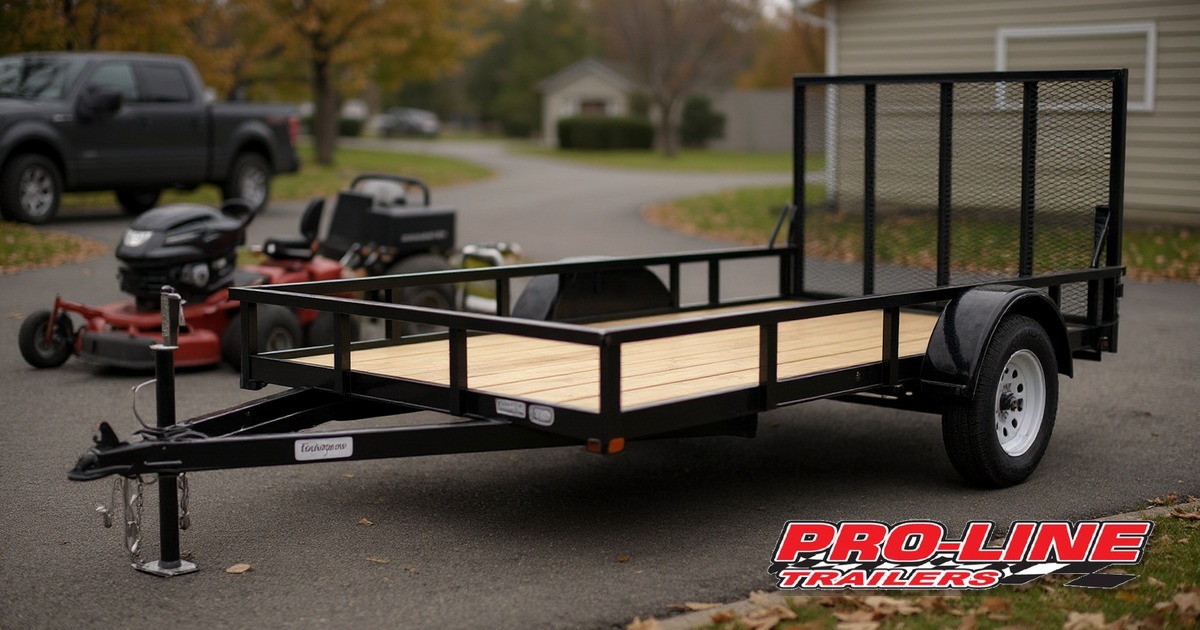
Not the broad category. The actual thing. A mower with a bagger and fuel cans. A compact tractor with an implement. A low car. Loose material. A side-by-side with gear. The right trailer is built around the work, loading method, and tow vehicle.
Before you look at colors, options, or a payment, get specific. These seven questions will make the conversation more useful and help you avoid buying a trailer that is almost right.
Decide what kind of buying conversation you need
Trailer buyers do not all want the same experience. Some already know the category and want a fast, clean transaction. Others are comparing a higher-cost or specialized build and need more time to work through construction, layout, options, timing, and total cost.
Neither buyer is wrong. The mistake is forcing both through the same process.
For a fast transaction, bring load dimensions, estimated loaded weight, tow-vehicle information, deadline, and preferred payment method. For commercial work or a custom layout, bring equipment photos and explain the normal workday. That lets the conversation match the decision rather than adding unnecessary steps.
1. What is the heaviest load you will actually carry?
“Most of the time” is not enough here. Write down the heaviest realistic load you expect to haul, including attachments, tools, fuel, cargo, and anything that stays on the trailer. If you haul a compact tractor, count the loader, mower deck, pallet forks, ballast, and chains. If you haul equipment for work, count the machine and the material that travels with it.
Then separate trailer weight from payload. A trailer’s GVWR is the maximum combined weight of trailer and cargo. It is not cargo capacity. The empty trailer uses part of that total.
Your tow vehicle matters too. Its owner’s manual and door-jamb information are the starting point for its towing and payload limits. The whole setup has to work together: truck, hitch, trailer, tires, axles, cargo, and the way the load is distributed.
NHTSA notes that proper tire pressure and observing tire and vehicle load limits are central to avoiding tire failure. Read its tire safety guidance before assuming a larger trailer alone solves a weight problem.
2. How much space does the load need in real life?
Length and width on paper can look generous until you account for the details.
Measure the item at its widest and longest points. Include implements, mirrors, doors, ramps, racks, spare tires, and anything that sticks out in travel position. For an enclosed trailer, consider interior and door-opening height as well as floor length. For a car, ground clearance and approach angle matter too.
Leave room for the loading process
A trailer that technically fits may still be awkward to load, tie down, inspect, or unload. Ask where you will stand and where the tie-down points will land.
The goal is a trailer that handles the job without a workaround every time.
3. What does loading and unloading look like?
This is where a lot of good-looking choices fall apart.
Will you drive the load on, winch it, roll it, lift it with equipment, or dump it? Does the load sit low, have small tires, or need a gradual approach? Are you loading on pavement, gravel, a job site, or a field? Do you need to get equipment off at the end without moving everything else first?
The answer affects deck height, ramp style and angle, gate design, winch access, and whether a tilt setup makes sense. Walk through the loading sequence to the final tie-down. A clumsy step gets worse in rain, darkness, or a late day.
4. Where will the weight sit on the trailer?
The same machine can tow very differently depending on where it sits. Load placement affects tongue weight, axle loading, handling, braking, and the amount of weight carried by the tow vehicle.
You do not need to guess your way through it. Start with the manufacturer information for your vehicle, hitch, and trailer, then plan the normal load position around those limits. A load may need to be positioned forward or back from where it first seems convenient. If the load changes from trip to trip, that is a reason to think carefully about capacity and how you will place it.
Think beyond the machine
Material, toolboxes, extra tires, generators, and fuel cans can change the balance. So can a machine with an attachment left on one end. Make a habit of treating cargo as part of the setup, not an afterthought after the main item is loaded.
5. How will you secure every piece of it?
Buying the right trailer does not remove the need for a sound securement plan. It should make that plan easier to execute.
Think about where chains, straps, nets, or tarps will attach. Consider whether you need multiple tie-down points, stake pockets, a rail, a bulkhead, or a way to keep smaller items from moving around the deck. Loose material and debris need their own plan.
NHTSA advises drivers to tie down cargo, secure large objects directly to the vehicle or trailer, consider a sturdy tarp or net, and double-check the load. Its Secure Your Load guidance also asks a useful question: what happens if you brake hard or hit a bump? Ask that before leaving the driveway, not after.
6. What roads, distances, and conditions are part of the job?
A trailer that makes sense for a short, level trip can feel different on mountain roads, narrow driveways, long highway runs, soft ground, or crowded job sites. Consider turns, backing space, parking, gate openings, storage, and loading alone. Think about the longest trip and the tow vehicle’s wheelbase, braking capability, and hitch rating. The trailer should fit the whole routine, not just the cargo.
7. What job needs to be easier six months from now?
The cheapest answer to today’s problem is not always the practical answer to tomorrow’s work.
Maybe the tractor will gain an attachment, the landscaping crew another mower, or the race car more gear. That does not mean buying more trailer than you can safely tow. Make a short list of the next one or two real changes, not wishful ones. The right decision fits current work, leaves sensible near-term room, and stays within the limits of the tow vehicle and equipment.
Bring the real job, not a vague category
You do not need every answer. Measurements, an equipment photo, your tow vehicle’s make and model, deadline, and an honest job description are enough to begin. If you plan to pay directly or explore financing, say so. It helps the team explain the correct transaction path after qualifying the trailer.
Ready to talk through the load? Call Pro-Line Trailers at (540) 334-4182 or start at prolinetrailersales.com.