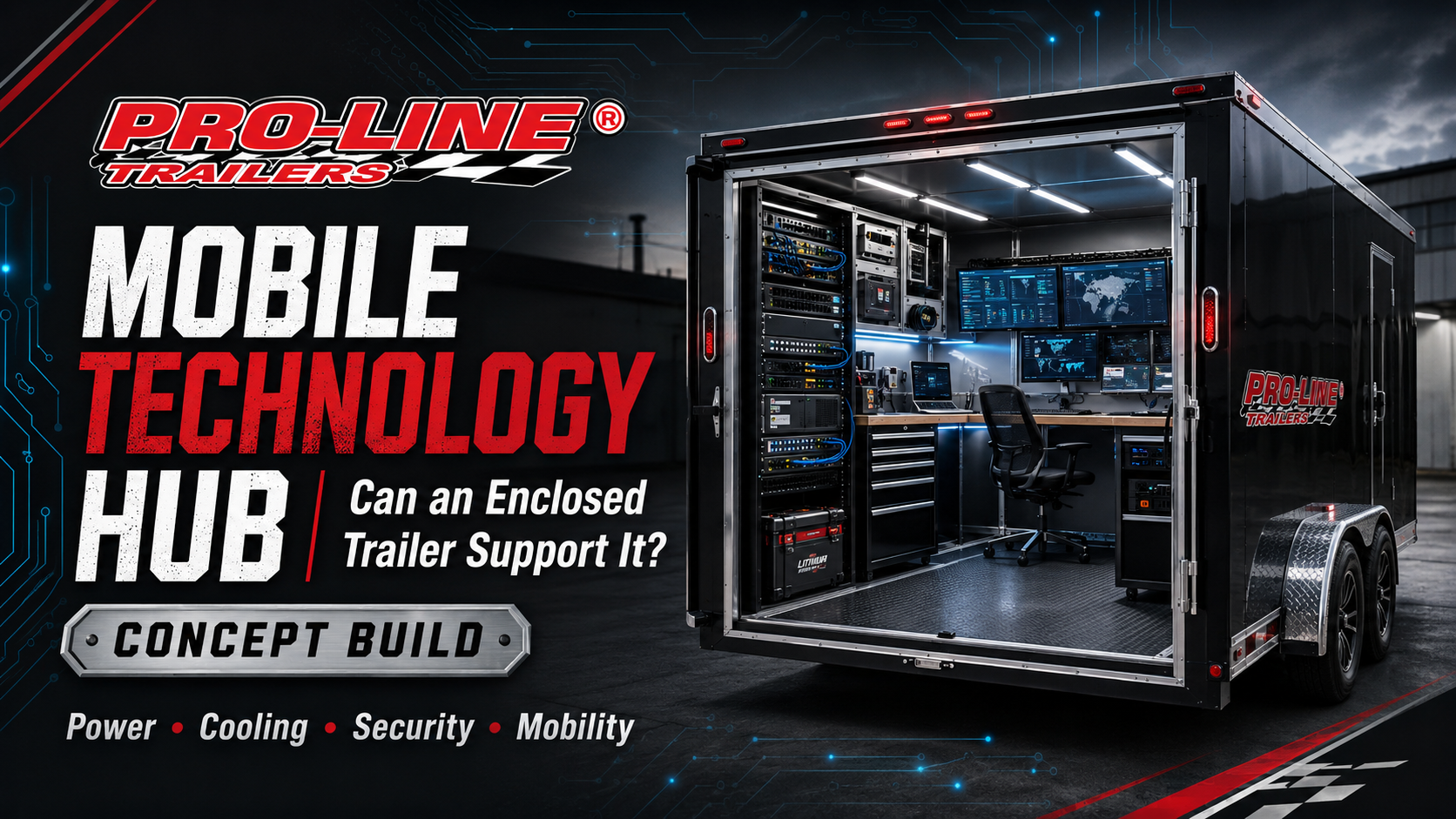
An enclosed trailer can become much more than a place to haul tools.
With the right platform, planning, and professional installation, it can support mobile communications, field operations, temporary connectivity, secure equipment transport, emergency response, and other specialized technology applications.
That does not mean every enclosed trailer can become a mobile data center.
It means a properly selected trailer can provide the physical foundation for a mobile technology system built around a specific job.
The trailer comes first. The specialized equipment comes next.
Can an enclosed trailer really support technology operations?
Yes, an enclosed trailer can support certain mobile technology applications when the project accounts for:
- Trailer size
- Payload capacity
- Axle ratings
- Equipment weight
- Weight distribution
- Electrical needs
- Cooling and ventilation
- Security
- Interior access
- Towing requirements
- Maintenance access
- Future expansion
The best results come from defining the job before choosing the trailer.
A field communications trailer has different needs than a secure equipment transport trailer. A mobile command unit has different requirements than a temporary network-support station.
The outside may look similar. The inside should reflect the actual work.
What is a mobile technology trailer?
A mobile technology trailer is an enclosed trailer adapted to support equipment, people, or systems used for communications, connectivity, field coordination, testing, monitoring, or technical service.
Possible applications include:
- Mobile communications support
- Temporary event connectivity
- Field command and coordination
- Disaster-response staging
- Network installation support
- Remote-site technology service
- Secure transport of sensitive equipment
- Temporary monitoring stations
- Mobile testing operations
- Edge-computing concepts
- Backup communications support
- Technology demonstration units
Some trailers may primarily transport equipment.
Others may serve as organized workspaces.
More advanced concepts may include racks, power systems, climate control, workstations, batteries, networking equipment, or specialty electronics.
The complexity of the build determines how much engineering and professional installation the project requires.
Start with the use case
Before choosing a trailer, answer one question:
What must this trailer do?
Avoid starting with screens, server racks, lighting, or interior design.
Start with function.
Ask:
- Will people work inside the trailer?
- Will it transport equipment or operate equipment?
- How many people need access?
- What equipment must remain powered?
- How much heat will the equipment produce?
- Will the trailer operate in hot or cold weather?
- How often will it move?
- How far will it travel?
- Will it need generator or shore-power access?
- Does equipment need protection from vibration?
- Will technicians need access to equipment while it operates?
- What security level does the equipment require?
These answers shape every decision that follows.
Choose the right trailer platform
The trailer is not an afterthought.
It is the foundation of the entire build.
If the trailer is too small, too light, poorly configured, or difficult to access, the interior systems will not fix the problem.
Trailer size
The trailer must provide enough space for:
- Equipment
- Storage
- Safe walking clearance
- Work surfaces
- Cable routing
- Cooling equipment
- Electrical components
- Maintenance access
- Future expansion
Do not design the interior so tightly that technicians must remove one component to reach another.
Space used for service access is not wasted space.
Interior height
Interior height matters when the build includes:
- Tall equipment racks
- Overhead cable routing
- Interior lighting
- Roof insulation
- Air-conditioning equipment
- Standing workstations
- Raised flooring
- Ceiling-mounted storage
A few extra inches can make a major difference after walls, insulation, flooring, and equipment get installed.
Door configuration
Door placement affects loading, daily access, security, and workflow.
Common options include:
- Rear ramp door
- Rear barn doors
- Side entry door
- Additional access doors
- Escape or service access points
A ramp door may help load wheeled racks, carts, cases, or generators.
Barn doors may offer simple cargo access without requiring ramp clearance.
A side door can give technicians fast access without exposing the entire interior.
The right configuration depends on how people and equipment move through the trailer.
Payload matters more than appearance
Technology equipment can add significant weight.
The build may include:
- Equipment racks
- Batteries
- Backup-power systems
- Generators
- Air-conditioning equipment
- Cabinets
- Workbenches
- Insulation
- Finished walls
- Flooring
- Cable
- Tools
- Spare parts
- Electronics
- Mounted displays
- Fire-protection equipment
- The spare tire
A trailer can run out of payload before it runs out of floor space.
That is why buyers must calculate the estimated finished weight, not just the weight of the empty trailer.
Understand trailer weight ratings
Before building, contractors should understand several basic numbers.
Gross vehicle weight rating
The gross vehicle weight rating represents the maximum allowable weight of the loaded trailer.
That includes:
- The trailer itself
- Installed equipment
- Tools
- Cargo
- Batteries
- Accessories
- Fluids
- Spare parts
Empty trailer weight
This is what the trailer weighs before the specialized build and cargo get added.
Available payload
Available payload is the difference between the trailer’s rated maximum weight and its empty weight.
Every modification reduces the remaining payload.
A contractor who adds 1,500 pounds of racks, batteries, climate control, wiring, walls, and equipment has 1,500 fewer pounds available for everything else.
Single axle or tandem axle?
A small, lightweight technology-support trailer may work with a single axle.
More complex builds will often benefit from a tandem-axle platform.
Single-axle platform
A single-axle trailer may work for:
- Light equipment transport
- Small field-support setups
- Compact demonstration units
- Limited tool and parts storage
- Shorter-distance use
Potential advantages include lower cost and easier maneuverability.
The tradeoff is lower capacity and less room for growth.
Tandem-axle platform
A tandem-axle trailer may fit:
- Heavier equipment
- Larger interiors
- Battery systems
- Multiple workstations
- Climate-control equipment
- Longer-distance travel
- More advanced mobile operations
Tandem axles may provide greater capacity and improved towing stability, but the trailer must still be loaded correctly.
Weight distribution can make or break the build
Total weight matters, but placement matters too.
Heavy equipment should not all sit at the rear, along one wall, or high above the floor.
Poor weight distribution can contribute to:
- Trailer sway
- Uneven tire wear
- Overloaded axles
- Excessive tongue weight
- Insufficient tongue weight
- Poor braking
- Difficult handling
- Structural stress
Batteries, equipment racks, generators, and cabinets require intentional placement.
The build team should evaluate individual component weight before finalizing the floor plan.
Plan the power system early
Power cannot come last.
Technology trailers may require some combination of:
- Shore power
- Generator power
- Battery backup
- Inverters
- Transfer equipment
- Power distribution
- Surge protection
- Grounding
- Uninterruptible power supplies
- Exterior power connections
- Interior outlets
- Dedicated equipment circuits
The correct setup depends on what equipment will operate and how long it must run.
Electrical work should follow applicable codes, equipment requirements, and professional installation standards.
A trailer dealership can help select the physical trailer platform. Qualified electrical and technology specialists should design and install specialized systems.
Cooling and ventilation are critical
Electronic equipment produces heat.
An enclosed trailer traps heat unless the design manages it.
Cooling needs depend on:
- Equipment heat output
- Outdoor temperature
- Sun exposure
- Insulation
- Trailer color
- Number of occupants
- Door-opening frequency
- Operating hours
- Airflow around equipment
- Required interior temperature
Possible solutions may include:
- Roof-mounted air conditioning
- Wall-mounted systems
- Exhaust fans
- Intake vents
- Insulation
- Equipment-specific airflow
- Hot-air separation
- Temperature monitoring
Adding air conditioning changes power needs, roof loading, interior clearance, trailer height, and total weight.
Plan cooling before the equipment layout gets locked in.
Protect equipment from vibration and movement
A trailer moves differently than a permanent building.
Road vibration, potholes, braking, turns, and repeated transport can affect sensitive equipment.
The build may need:
- Secured racks
- Shock-resistant mounting
- Tie-down systems
- Padded storage
- Locking drawers
- Cable strain relief
- Protected connectors
- Equipment transport cases
- Floor-mounted brackets
Do not assume that equipment designed for a stationary room can safely travel without additional protection.
Build security into the design
A mobile technology trailer may carry valuable equipment, proprietary systems, sensitive information, or critical replacement parts.
Security should include more than a padlock.
Consider:
- Strong door locks
- Reinforced access points
- Lockable cabinets
- Alarm systems
- GPS tracking
- Cameras
- Exterior lighting
- Access-control systems
- Equipment inventory
- Secure parking
- Hidden cable and power connections
- Procedures for keys and credentials
No trailer becomes theft-proof.
A layered security plan can reduce exposure and make unauthorized access more difficult.
Design the interior for technicians
A visually impressive interior does not guarantee a useful one.
Technicians need enough space to work safely and maintain the equipment.
Plan for:
- Clear aisles
- Door clearance
- Work surfaces
- Seating
- Equipment access
- Cable management
- Lighting
- Tool storage
- Replacement-part storage
- Emergency exits
- Fire extinguishers
- Maintenance clearance
- Safe access to electrical equipment
Frequently used tools and controls should remain easy to reach.
Heavy equipment should sit low when practical.
Cables should not cross walkways or block access panels.
Think about exterior requirements
The outside of the trailer may need to support more than towing.
Possible exterior considerations include:
- Shore-power connections
- Generator connections
- Ventilation openings
- Air-conditioning equipment
- Antennas
- Satellite equipment
- Cable access points
- Stabilizer jacks
- Exterior lighting
- Security cameras
- Equipment compartments
- Awning or weather protection
- Branding and identification
Every exterior modification may affect weather sealing, structure, height, balance, or maintenance.
Plan those modifications before cutting openings into the trailer.
Do not forget the tow vehicle
The tow vehicle must handle the completed trailer, not the empty shell.
Check:
- Maximum towing capacity
- Vehicle payload
- Hitch rating
- Tongue-weight limits
- Brake-controller requirements
- Trailer brake condition
- Tire capacity
- Electrical connection
- Weight-distribution needs
- Operating terrain
- Highway travel
- Driver experience
A trailer rated for the build still needs a properly matched tow vehicle.
Mobile technology trailer planning checklist
| Planning Area | Questions to Answer |
|---|---|
| Use case | What must the trailer do every day? |
| Size | How much equipment, access, and workspace are required? |
| Payload | What will the completed build weigh? |
| Axles | Does the platform support the load and future growth? |
| Doors | How will people and equipment enter and exit? |
| Power | What powers the systems, and for how long? |
| Cooling | How will heat leave the trailer? |
| Security | How valuable or sensitive is the equipment? |
| Vibration | How will equipment stay protected during travel? |
| Workflow | Can technicians reach and service everything? |
| Tow vehicle | Can the vehicle safely tow the finished trailer? |
| Maintenance | How will the trailer and installed systems be serviced? |
Common mistakes to avoid
Buying the trailer before defining the system
The trailer should match the equipment, people, power, cooling, access, and weight requirements.
Underestimating final weight
Walls, racks, batteries, wiring, cabinets, air conditioning, and equipment add weight quickly.
Designing only for installation
The equipment also needs inspection, replacement, cleaning, and repair access.
Ignoring heat
A trailer can become dangerously hot, even when the outside temperature feels manageable.
Treating all cargo weight the same
A concentrated equipment rack creates different loading concerns than evenly distributed supplies.
Forgetting travel conditions
A system that works while parked must also survive braking, vibration, turns, weather, and highway travel.
Leaving no room for expansion
Technology changes. Equipment gets added. A build with no spare capacity can become obsolete quickly.
Using unqualified installers
Specialized electrical, cooling, networking, fire-protection, and equipment systems require qualified professionals.
What role does Pro-Line Trailers play?
Pro-Line Trailers helps customers select the enclosed trailer platform that supports the planned use.
That may include discussing:
- Trailer dimensions
- Interior height
- Axle configuration
- Payload
- Door options
- Towing requirements
- Accessory needs
- Future customization
- Financing
- Service
- Parts
Pro-Line does not replace the qualified engineers, electricians, technology installers, or equipment specialists required for advanced systems.
The goal is to help customers avoid starting a specialized build with the wrong trailer.
Keep the platform road-ready
A mobile technology trailer still needs regular trailer maintenance.
Pro-Line’s service department can help with:
- Axle service
- Tire upgrades
- Brake service
- Wiring and lighting repairs
- Safety-chain upgrades
- Roof replacement
- Panel replacement
- Double-door replacement
- Parts installation
- Trailer inspections
Technology equipment cannot help the business when the trailer carrying it cannot safely reach the job.
Frequently asked questions
Can a cargo trailer hold server racks?
An enclosed trailer may physically support properly secured equipment racks when the trailer’s floor, axles, payload, weight distribution, cooling, power, and towing requirements match the completed build. A qualified specialist should evaluate the proposed system.
Does a mobile technology trailer need air conditioning?
Many electronics-based applications need active cooling or ventilation. The correct solution depends on equipment heat output, operating conditions, insulation, trailer size, and required interior temperature.
Can a trailer operate from a generator?
Some mobile technology systems use generator power, but the generator, electrical distribution, grounding, fuel storage, ventilation, noise, and equipment requirements need professional planning.
What trailer size works best?
There is no universal size. The trailer must fit the equipment, safe access, cooling systems, power components, storage, maintenance clearance, and future growth.
Is a tandem-axle trailer better for a mobile technology build?
Tandem axles often suit heavier or more complex builds because they may provide greater payload capacity and towing stability. The final choice depends on the loaded weight, trailer specifications, and tow vehicle.
Can Pro-Line build the technology systems inside the trailer?
Pro-Line can help customers select a suitable trailer platform and discuss trailer-related options, service, and accessories. Qualified specialists should design and install advanced electrical, networking, cooling, security, and technology systems.
The trailer is the foundation
A mobile technology concept can look impressive on a screen.
The real test comes when the system must travel safely, operate reliably, stay cool, protect expensive equipment, and give technicians room to work.
That starts with the right trailer.
Define the job.
Calculate the weight.
Plan power and cooling.
Protect the equipment.
Match the tow vehicle.
Leave room for service and growth.
Then build the system around a platform designed to support the work.
Start with the right enclosed trailer
Planning a mobile communications, field-support, event-connectivity, or specialized technology trailer?
Browse enclosed trailer inventory or call Pro-Line Trailers to discuss the platform before the interior build begins.
For trailer lighting, locks, tie-downs, replacement components, and accessories.
Ask about current inventory, financing, service, and available trailer options.
Pro-Line Trailers: For Work and Play.